


The 56-Hour Caregiver Cap: How to Build Your Trusted Care Team
Key Takeaways: TL;DR
- Individual Limit: One caregiver = 56 hours max.
- The DCSC is Required: The Direct Care Services Calculator is now the mandatory tool used to determine your hours based on strict "Task Standards.
- Annual Soft Caps: Personal Care (2,500 hrs/yr) and HMA (4,750 hrs/yr) limits are now codified in rule.
- LRP Victory: Parents of adults are officially NOT considered Legally Responsible Persons (LRPs). Only spouses are.
- 30-Day Rule: Exception requests must be submitted 30 days before your plan begins.
How can I keep my Medicaid hours with the 56-hour cap?
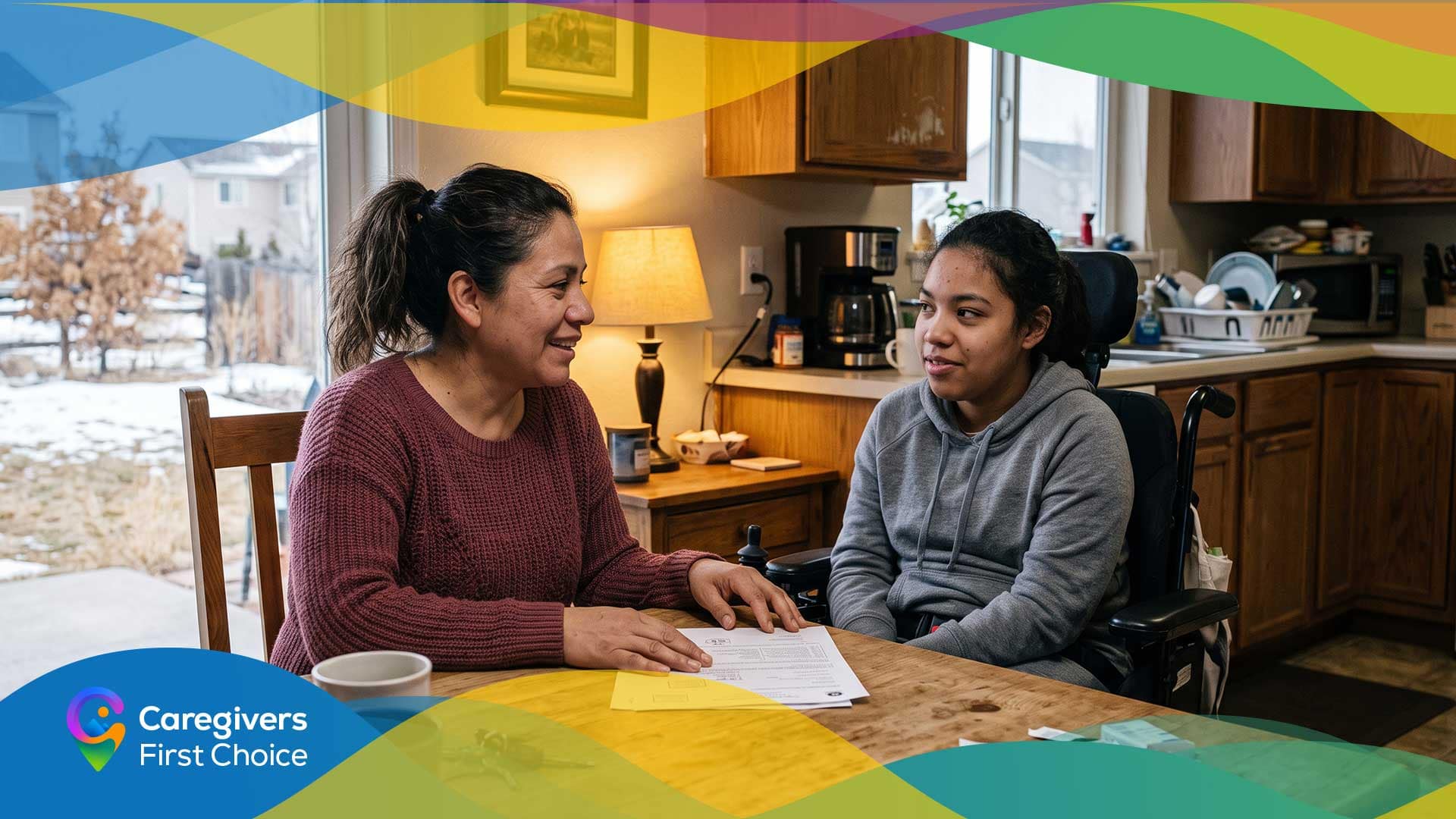
To keep your Medicaid hours under the new 56-hour cap, you should transition to a "Trusted Team" model. While an individual is limited to 56 hours per week, the member can still receive their full authorized hours if the time is split between two or more caregivers. Caregivers First Choice supports this transition by onboarding your family members or friends with Radical Ease, ensuring the care stays within your household.
The Challenge of the Single-Caregiver Household
For single parents or those without local relatives, the 56-hour cap is a direct threat to safety. Under the new Section 8.7502.II, the state defines Extraordinary Care as services that exceed what a family member would "ordinarily perform" for someone of the same age.
If you are a single caregiver providing this level of care, the March 12 JBC Vote and SB 25-11-06-B mean you must now prove your "Extraordinary Care" through a multi-tier review process.
The Exception Process: A Difficult Path
Per the new 8.7607.A rules, the exception process is now a multi-tiered legal requirement involving Embedded Triggers in the state's calculator.
The Three Tiers of Review:
- The DCSC Trigger: When your requested hours exceed "Task Standards" (the maximum time allowed for a task like bathing), the calculator automatically triggers an exception requirement.
- Professional Review: A Case Management Supervisor or an Alternative Qualified Professional (such as a Registered Nurse) must review the record to ensure the request is "age-appropriate" and "non-duplicative."
- Department Approval: For any hours exceeding the Annual Soft Caps (e.g., 2,500 hours for Personal Care), HCPF must give final authorization.
Crucial Win for Parents of Adults: Rule 8.7502.W clarifies that for adults, an LRP is limited to a spouse. This means parents of adult children are no longer restricted to the 260-hour annual Homemaker cap.
Your Next Steps
If you are currently providing more than 56 hours of care per week, use the questions below to determine your best path forward.
Your best path is building a Trusted Team. We handle the Radical Ease of onboarding them so you can keep your full care plan intact.
Continue to Step 2
If the state says a task "should only take 15 minutes" but your loved one's condition requires 45, you need a Clinical Exception. We work with your Case Manager to provide the documentation required for the RN/Supervisor review.
If you simply need more total hours than the 56-hour individual cap allows, we must document the Staffing Paradox.
Read the Full SB 25-11-06-B Report
Why CFC is Your Best Partner
The new Task Standards (8.7502.JJ) are designed to facilitate conversations, but they are often used as "hard stops" by agencies. We don't accept the default.
- Radical Ease: We help navigate the "Direct Care Services Calculator" to ensure your "Extraordinary Care" is documented correctly the first time.
- Unfiltered Transparency: We are tracking the final adoption of these rules to ensure our families are never caught off guard.
- Expertise: We understand the difference between "Age-Appropriate" care and the specialized needs of your family.

While I appreciate efforts to help families adapt, the 56-hour caregiver cap disproportionately harms single-parent households and families who rely on one consistent caregiver. Many of us were already reduced to roughly 16 hours per day under prior policies, and this additional cap ignores the realities of medically complex children who require continuity and familiarity in their care.
The idea of building a “village” also assumes that extended family and friends are available, but in reality most already work full-time and cannot absorb additional caregiving hours. For families without access to multiple trusted, available caregivers, this cap creates a snowball effect that will grow into a much larger access problem. Frequent caregiver changes are not just inconvenient; for some children, they are destabilizing and unsafe. Policy discussions need to better reflect these real-world constraints.
Shannon,
Thank you so much for sharing this honest and important perspective. You are absolutely right—policy changes like this disproportionately impact single-parent households and families managing complex medical needs where continuity isn’t just a preference, but a safety requirement.
We understand that for many families, the idea of a ‘village’ effectively doesn’t exist because friends and family are working full-time or simply cannot provide the specialized level of care your child needs. We know that bringing in new caregivers is often destabilizing and that the reality of ‘Hour 57’ is far more stressful than policy discussions often reflect.
While we are bound to operate within these new state regulations, we fully see and validate the heavy burden this places on you. We are committed to advocating for flexibility wherever possible. If you are open to it, please reach out to us directly. We would value the chance to listen to your specific situation and see if there are any creative solutions or ‘safety net’ options we can offer to help you navigate this difficult transition.
Thank you for the thoughtful response and for acknowledging that continuity of care is a safety requirement, not a preference. I truly appreciate that recognition.
I do want to add that for some families of medically complex minor children, “creative solutions” such as onboarding, training, or rotating additional caregivers are not realistic options. Managing multiple therapies each week, homeschooling, and complex care routines already places a significant cognitive and emotional load on parents as is. Adding ongoing caregiver recruitment, training, and supervision often creates more stress and instability rather than support.
Additionally, the expectation that families can rely on extended family or friends to take on more paid caregiving hours on top of their own full time jobs is increasingly unrealistic and, in many cases, effectively obsolete. Most households are already working at capacity just to meet basic living needs.
This is why clear, accessible exception pathways are so important. For children who require consistent, trusted caregivers, flexibility at the policy level is not a convenience it’s necessary to prevent care disruption and harm.
I hope these realities continue to be elevated as the state considers how these caps are implemented.